Tuesday, 19 April 2016

Monday, 18 April 2016

Sunday, 17 April 2016

Saturday, 16 April 2016
Evaluation Question 1 - In What Ways do the Media Products Use, Develop or Challenge Forms and Conventions of Real Media Products?
In What Ways do the Media Products Use, Develop or Challenge Forms and Conventions of Real Media Products?
Throughout the process of creating my products, and the development of the short film, I have attempted to keep the products as professional as possible. In order to do this, I decided to stick to conventions for the most part, but still wanted to allow my creativity to come through, and therefore broke some conventions in order to keep the content of the short film fresh and different. Within this evaluation, the conventions and how they are broken or conformed to within my short film, poster and magazine spread will be analysed to show their usage or breakage of conventions.
The short film has conformed to a large amount of the conventions within the genre and medium, but has still broken conventions of the form itself. The reason I chose to break conventions was due to wanting to make the short film slightly different in order to keep it as something new, within reason. some of the conventions that exist within this products are based around it's narrative ability and environments. Often in science fiction short films, snow and icy conditions are used in order to present a setting that represents the rough lives of the main characters, but in my film I used this setting to forward the plot through showing what the protagonists could do, which would become important later on.
 In my poster ancillary text, I have opted to use the conventions found within a large amount of posters of displaying the main character in the center and an object of plot importance in the background behind them, with surrounding scenery and borders covered with a similar theme to the main setting of the film. In this case, I have used trees and grass around the edge to create a boarder, to which the character is in the middle. The battery, an important plot point in the film, is shown as very large and behind the main character, with a glow around it to draw the viewer's attention to it as the main focus of the film. This is conventional, and through researching the products i learned that these positions are common not only on short film posters or even posters of the genre, but that they expand to other genres too, such as action and adventure films.
 Additionally to this, all object on the poster have been replaced by their outlines filled with a coloured space-styled background. This is due to other inspirations of minimalist posters of sci-fi films and shows, which often use a single colour or multiple colours to represent a specific scene from the film or just to represent it as a whole. This minimalistic styling was incorporated into the poster due to it being quite conventional of a large amount of sci-fi films, especially in more recent posters. Another conventional part of minimalistic posters is the use of negative space, and using the environment to highlight details within what's shown to create a new image, in a matter similar to a bricolage. In my poster, I used this negative space in the poster to show the antagonist, the small ball-like robot. This is similar to the Return of the Jedi poster that I used for referencing, as the negative space in this show's the antagonist through using tree branches to denote detail. The basic shape of the antagonist is made out of the negative space on the poster, with the eye being the protagonist in the center.

 In my magazine review, I have used a number of conventions for other film magazines, but the main example I looked at for conventions was Empire. As Empire is a popular film review magazine it seemed perfect for finding conventions relating to double page spreads and film reviews. When compared, both magazines contain similar conventions relating to layout, colour and style. My magazine makes use of a simplistic layout that is relatively uncluttered, leaving plenty of space for text. There is a review column towards the bottom, which gives a short overview of the film's details, such as plot, director and title, along with release date.
 This was done as it keeps a professional appearance, as the magazines i looked at took used a fairly long section on the film for the bulk of the story, but had a smaller, more compact review on the side. This helps people who are simply flicking through the magazine. The image used displays the battery rendered using a few more camera effects to make it seem slightly more colourful, and to increase the reflection quality of the battery itself. This was done as the battery is the main plot point of the short film, and is what drives the plot forward; this makes displaying it in promotional material very important to convey a basic concept of the story to the audience. It is often conventional to display either an object of plot importance or a character in this space, so this follows common conventions. Alongside this, there is a small box in the bottom right that explains this to the audience.
The short film follows the typical narrative structure that can be seen within most films, best broken down into Tzvetan Todorov's (1977) 5 narrative structure stages; the initial stable equilibrium, a disequilibrium is then created, this equilibrium is now acknowledged, action is taken to re-create the equilibrium, and then the creation of a new equilibrium. In this basic form, the narrative of my product can be broken down into the same five basic sections; the robots need power, the antagonist is seen observing them and then disrupting the equilibrium by planning to steal the battery, they are attacked and their power is stolen, forcing them to recognise that a disruption has taken place, action is taken to restore the equilibrium by attacking the antagonist, and then a new equilibrium is restored, having one less robot but having gained the battery. Following this basic format for a story is conventional of more genres, and while it is quickly becoming more commonplace to re-order the order of the plot within the sci-fi genre, it is still considered conventional to have this layout.
In comparing my work to Tzvetan Todorov's (1977) 5 narrative structure stages, the narrative fits in well, making good use of the conventions of regular narrative structures. this was a better convention to adhere to due to it's structure rules helping to shape the story, helping it to be more understandable and accessible by a greater audience. That being said, my product still challenges the theory through it's lack of vocals, as only incomprehensible robotic mumbles are used instead of voice acting, meaning that the entire narrative must be conveyed through a visual means. This breaks the convention of explaining everything to the audience, while still allowing the story to make sense and giving the audience a sense of understanding of the narrative.
This story was chosen over a more abstract choice due to it being largely more conventional to stick to a regular, more understandable story. Using the story concept I came up with, I wanted to attempt to head in a different direction to previous years. One of the biggest faults that I have had previously with production has been the organisation of actors and roles, but when designing this product I wanted to aim to reduce the input of other people in the film as much as possible. In doing this, I was granted a greater creative freedom throughout the creation process.
Characters are a very clear convention of most films and TV programs, and within a short film there tends to be a clear trend of having 2-3 main characters. This allows for enough time for each of these three to receive appropriate character development and for their individual traits to show through. often, these character's development is limited due to the runtime of the film, and therefore often they don't have back story or go in-depth about specifics of the character. Having a smaller cast of characters allows them to still get the development that they need for the audience to relate to them while still only having a small runtime.
To show this, the Big Bank short film promotion for Payday 2 would be a good example. It contains 3 main characters/character groups, those being the customer, the bank worker and the bank robbers. this fits the conventional character amounts for short films, and allows for enough character development to be displayed for them to play their roles to an effective standard. My character group was slightly larger then this on the whole, but generally only has 3 active characters. This is due to the Orange robot being destroyed, allowing for the Ball robot to take his place.
Within the short film, Levi Strauss' theory of binary opposites was demonstrated in the main group of robots being the protagonists, with the Ball and his backup as the antagonists. The main reason for this is due to the Ball being effectively useless without the others to back him up, whereas each of the protagonists has their own advantages. This is further shown through the protagonists each having their own dominant character trait; Orange is curios, which is shown through them being the one to break into the cavern and messing around with the IPod, Green is impetuous and impulsive, as shown by him constantly acting without thinking about the consequences of his actions, and Blue is thoughtful and the leader, as shown by him always being at the forefront (while present), and waiting for his opportunity to jump on the Ball. This is contrasted by the binary opposite; the antagonists. They are very alike and work in almost a hive mind; they don't think for themselves as much as they just act together in a mechanical and have more of a sudden, jerking motion to them when they move.
Overall, my film meets a large amount of the conventions set out by other short films, as well as conforming to a number of theories that are help common in the practise of film making. In meeting these conventions, I have made my work appear more professional through abiding by the rules set out by popular and well known films, as well as broken some to ensure that my short film is still something fresh and interesting to the viewer.
Throughout the process of creating my products, and the development of the short film, I have attempted to keep the products as professional as possible. In order to do this, I decided to stick to conventions for the most part, but still wanted to allow my creativity to come through, and therefore broke some conventions in order to keep the content of the short film fresh and different. Within this evaluation, the conventions and how they are broken or conformed to within my short film, poster and magazine spread will be analysed to show their usage or breakage of conventions.
The short film has conformed to a large amount of the conventions within the genre and medium, but has still broken conventions of the form itself. The reason I chose to break conventions was due to wanting to make the short film slightly different in order to keep it as something new, within reason. some of the conventions that exist within this products are based around it's narrative ability and environments. Often in science fiction short films, snow and icy conditions are used in order to present a setting that represents the rough lives of the main characters, but in my film I used this setting to forward the plot through showing what the protagonists could do, which would become important later on.
 In my poster ancillary text, I have opted to use the conventions found within a large amount of posters of displaying the main character in the center and an object of plot importance in the background behind them, with surrounding scenery and borders covered with a similar theme to the main setting of the film. In this case, I have used trees and grass around the edge to create a boarder, to which the character is in the middle. The battery, an important plot point in the film, is shown as very large and behind the main character, with a glow around it to draw the viewer's attention to it as the main focus of the film. This is conventional, and through researching the products i learned that these positions are common not only on short film posters or even posters of the genre, but that they expand to other genres too, such as action and adventure films.
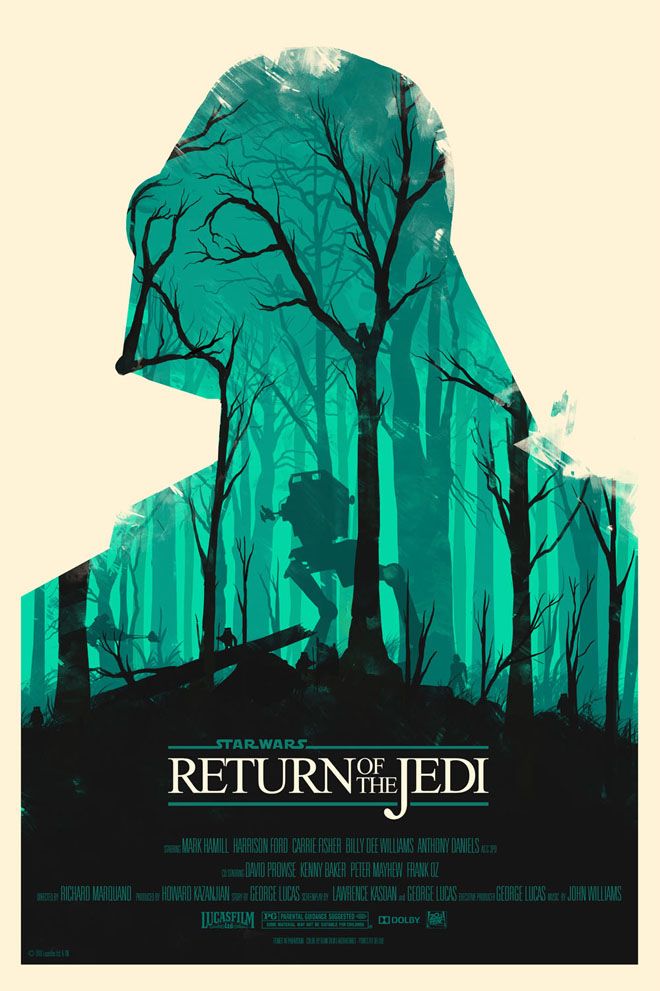 Additionally to this, all object on the poster have been replaced by their outlines filled with a coloured space-styled background. This is due to other inspirations of minimalist posters of sci-fi films and shows, which often use a single colour or multiple colours to represent a specific scene from the film or just to represent it as a whole. This minimalistic styling was incorporated into the poster due to it being quite conventional of a large amount of sci-fi films, especially in more recent posters. Another conventional part of minimalistic posters is the use of negative space, and using the environment to highlight details within what's shown to create a new image, in a matter similar to a bricolage. In my poster, I used this negative space in the poster to show the antagonist, the small ball-like robot. This is similar to the Return of the Jedi poster that I used for referencing, as the negative space in this show's the antagonist through using tree branches to denote detail. The basic shape of the antagonist is made out of the negative space on the poster, with the eye being the protagonist in the center.
 In my magazine review, I have used a number of conventions for other film magazines, but the main example I looked at for conventions was Empire. As Empire is a popular film review magazine it seemed perfect for finding conventions relating to double page spreads and film reviews. When compared, both magazines contain similar conventions relating to layout, colour and style. My magazine makes use of a simplistic layout that is relatively uncluttered, leaving plenty of space for text. There is a review column towards the bottom, which gives a short overview of the film's details, such as plot, director and title, along with release date.
The short film follows the typical narrative structure that can be seen within most films, best broken down into Tzvetan Todorov's (1977) 5 narrative structure stages; the initial stable equilibrium, a disequilibrium is then created, this equilibrium is now acknowledged, action is taken to re-create the equilibrium, and then the creation of a new equilibrium. In this basic form, the narrative of my product can be broken down into the same five basic sections; the robots need power, the antagonist is seen observing them and then disrupting the equilibrium by planning to steal the battery, they are attacked and their power is stolen, forcing them to recognise that a disruption has taken place, action is taken to restore the equilibrium by attacking the antagonist, and then a new equilibrium is restored, having one less robot but having gained the battery. Following this basic format for a story is conventional of more genres, and while it is quickly becoming more commonplace to re-order the order of the plot within the sci-fi genre, it is still considered conventional to have this layout.
In comparing my work to Tzvetan Todorov's (1977) 5 narrative structure stages, the narrative fits in well, making good use of the conventions of regular narrative structures. this was a better convention to adhere to due to it's structure rules helping to shape the story, helping it to be more understandable and accessible by a greater audience. That being said, my product still challenges the theory through it's lack of vocals, as only incomprehensible robotic mumbles are used instead of voice acting, meaning that the entire narrative must be conveyed through a visual means. This breaks the convention of explaining everything to the audience, while still allowing the story to make sense and giving the audience a sense of understanding of the narrative.
This story was chosen over a more abstract choice due to it being largely more conventional to stick to a regular, more understandable story. Using the story concept I came up with, I wanted to attempt to head in a different direction to previous years. One of the biggest faults that I have had previously with production has been the organisation of actors and roles, but when designing this product I wanted to aim to reduce the input of other people in the film as much as possible. In doing this, I was granted a greater creative freedom throughout the creation process.
Characters are a very clear convention of most films and TV programs, and within a short film there tends to be a clear trend of having 2-3 main characters. This allows for enough time for each of these three to receive appropriate character development and for their individual traits to show through. often, these character's development is limited due to the runtime of the film, and therefore often they don't have back story or go in-depth about specifics of the character. Having a smaller cast of characters allows them to still get the development that they need for the audience to relate to them while still only having a small runtime.
To show this, the Big Bank short film promotion for Payday 2 would be a good example. It contains 3 main characters/character groups, those being the customer, the bank worker and the bank robbers. this fits the conventional character amounts for short films, and allows for enough character development to be displayed for them to play their roles to an effective standard. My character group was slightly larger then this on the whole, but generally only has 3 active characters. This is due to the Orange robot being destroyed, allowing for the Ball robot to take his place.
Within the short film, Levi Strauss' theory of binary opposites was demonstrated in the main group of robots being the protagonists, with the Ball and his backup as the antagonists. The main reason for this is due to the Ball being effectively useless without the others to back him up, whereas each of the protagonists has their own advantages. This is further shown through the protagonists each having their own dominant character trait; Orange is curios, which is shown through them being the one to break into the cavern and messing around with the IPod, Green is impetuous and impulsive, as shown by him constantly acting without thinking about the consequences of his actions, and Blue is thoughtful and the leader, as shown by him always being at the forefront (while present), and waiting for his opportunity to jump on the Ball. This is contrasted by the binary opposite; the antagonists. They are very alike and work in almost a hive mind; they don't think for themselves as much as they just act together in a mechanical and have more of a sudden, jerking motion to them when they move.
Overall, my film meets a large amount of the conventions set out by other short films, as well as conforming to a number of theories that are help common in the practise of film making. In meeting these conventions, I have made my work appear more professional through abiding by the rules set out by popular and well known films, as well as broken some to ensure that my short film is still something fresh and interesting to the viewer.
Friday, 15 April 2016
Evaluation Question 2 - How Effective is the Combination of your Main Product and Ancillary Texts?
How Effective is the Combination of your Main Product and Ancillary Texts?
Thursday, 14 April 2016
Evaluation Question 3 - What Have You Learned from your Audience Feedback?
What Have You Learned from your Audience Feedback?
http://jameswestonisthebeston.blogspot.co.uk/2014/04/short-film-bernard-bird-audience.html
In order to gather audience feedback, I used Survey monkey to get opinions and ratings on my products. This consisted of a questionnaire, which was distributed to a few people which cover a wide audience range. The age group that was used is around the 17-19 area, as that is the intended audience for the film. The film was shown to all of these, which then were given the survey to complete. The results shows the two most common groups that these people fell into.
This is the survey's first question, filled with the two most popular answers. Both of these are very good reflections on my film, as they give good ratings for the film. Given that this is immediately after viewing, this is good, as it leaves an impression upon the viewer. The other questions reflect this, as they will have been answered slightly after seeing the film, and they remain positive results. Using this information, I have learned that my film is popular with my target audience, and that it as therefore been successful.


http://jameswestonisthebeston.blogspot.co.uk/2014/04/short-film-bernard-bird-audience.html
In order to gather audience feedback, I used Survey monkey to get opinions and ratings on my products. This consisted of a questionnaire, which was distributed to a few people which cover a wide audience range. The age group that was used is around the 17-19 area, as that is the intended audience for the film. The film was shown to all of these, which then were given the survey to complete. The results shows the two most common groups that these people fell into.
This is the survey's first question, filled with the two most popular answers. Both of these are very good reflections on my film, as they give good ratings for the film. Given that this is immediately after viewing, this is good, as it leaves an impression upon the viewer. The other questions reflect this, as they will have been answered slightly after seeing the film, and they remain positive results. Using this information, I have learned that my film is popular with my target audience, and that it as therefore been successful.


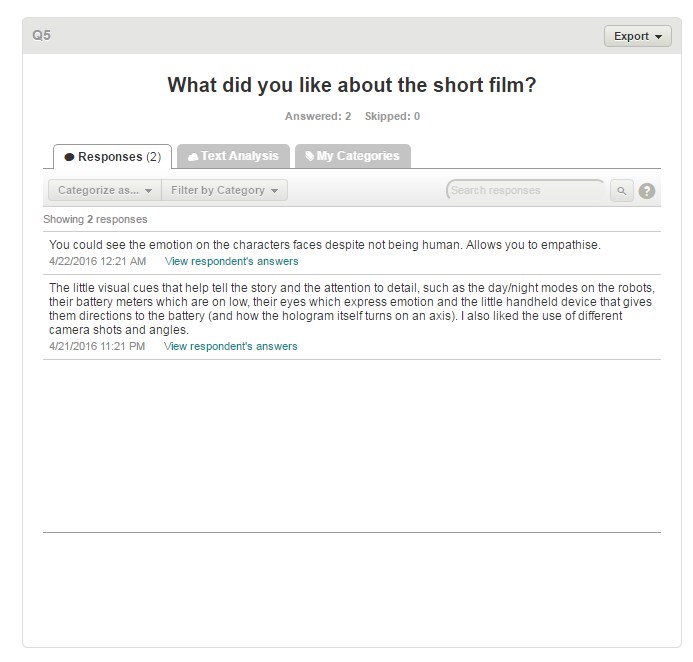


Overall, the Feedback that I have received from the popular answers to the questionnaire are mostly positive. Within question one, both groups gave good ratings, with one being 4 stars and one being 5. Due to one of these being lower then the other, this shows that there is still room for improvement. Question 2 was similarly well received, with answers relating to the level of detail and effects being the most common. alongside this, comments were also made about the animation quality, as well as the characters and narrative developed.
On Question 3, both groups found that the film was effective in it's narrative and visual style, long with the music. This also leaves room or improvement, but is a good starting point, and shows the film, as being popular with these groups. For Question 4, both groups answered highly, with one giving an 8 and the other giving a 9. However, these ratings could be improved, and therefore the method through which the narrative is explained requires improvement in order to be the best that it can be.
For Question 5, both groups had comments to write about the film, both being good. The first group answered with a shorter answer, mentioning the robot's eyes and faces being more effective due to their mobility, allowing for a greater range of emotions to be expressed, which the group notes allows the audience to empathize better. The second group's responses are far larger and much more detailed, mentioning about how there are small visual cues that help to tell the story, to which they then go on to examples from the short film, such as the day/night modes, the eyes on the robots along with the small device that directs them to the battery. They also go on to mention the cinematography of the film, mentioning that they liked the use of camera shots and angles.
Within Question 6, the question asks for dislikes about the film, but the responses do not list much that they didn't like. The first group mentions the ending, saying that it seemed somewhat sudden, which is a complaint that I agree with. Unfortunately, due to the time constraints of the video, a more elaborate ending was not able to be added, but it should be something that could be tweaked should the beginning be shortened or simplified. As for the second group, they had no dislikes that they commented on in the film.
Overall, with these responses being very positive, The reviews reflect that the audience likes the film. However, this does not mean that it is without flaws. Within the 'What Improvements Would You Recommend?', the common responses were that the scenes earlier on in the film should be shortened down in order to focus more on the ending. Following this advice would allow for more time to focus on the ending, as suggested, and make more of the finale. This could make the ending more satisfying for the viewer, leaving the film with a better and more memorable final scene which is longer and more plot-related.
The other comment on this question is that the sound effects could have been better utilized. They point out specifically the robot's 'voices', saying that they should be used more within the film, as well as that more ambient sounds and noises could have been used. This is something that I agree with, and on reflection more sounds could have been added. From this feedback, I have learnt that the audience would like the pacing of the film to be altered, as well as sound and dialogue effects.
Wednesday, 13 April 2016
Evaluation Question 4 - How Did You Use Media Technologies in the Construction and Research, Planning and Evaluation Stages?
How Did You Use Media Technologies in the Construction and Research, Planning and Evaluation Stages?
Throughout the development of my short film, I had primarily used different software and hardware in order to make it, as the CGI required a large amount of technological involvement in order to work. One of the two most important programs in the making of the film was Unity3D, the 3D graphical engine that I created my animation in. To give demonstrations of how this has been used, along with the 3D modelling tool Blender, an interactive guide to the assets used throughout the film is given in the demo below.
https://drive.google.com/open?id=0ByeAkfBNgEqsUkFUdFZyTFFuMGc
Throughout the development of my short film, I had primarily used different software and hardware in order to make it, as the CGI required a large amount of technological involvement in order to work. One of the two most important programs in the making of the film was Unity3D, the 3D graphical engine that I created my animation in. To give demonstrations of how this has been used, along with the 3D modelling tool Blender, an interactive guide to the assets used throughout the film is given in the demo below.
https://drive.google.com/open?id=0ByeAkfBNgEqsUkFUdFZyTFFuMGc
Tuesday, 12 April 2016
Ancillary Text 1: Draft Poster
Using the minimalist styling shown in the research for my poster, along with the posing demonstrated by the short film posters, I have began to draft a poster using a combination of these features.


Thursday, 24 March 2016
Ancillary Text 1: Poster for the Film - Research
There are few short film posters that feature similar themes to my film, but i have managed to find a few to take inspiration and ideas from. I would like to create a pastiche of these posters using my protagonists as the centerpiece, and then put them together in the form of a bricolage to create something new. there are a few posters that i will be taking inspiration from, all of which revolve around the sci-fi theme to keep consistency and genre throughout the poster. some of the ideas that i am currently thinking about including would be the use of shadows and silhouettes, minimalist two-colour styles and a use of negative space.
Some of the posters that I am considering taking inspiration from would be from various short films that focus around similar subjects, i.e. sci-fi, robots, machinery and the cold winter themes that run throughout the setting. for the poses and object arrangement within the poster, I will take a look at the following posters:


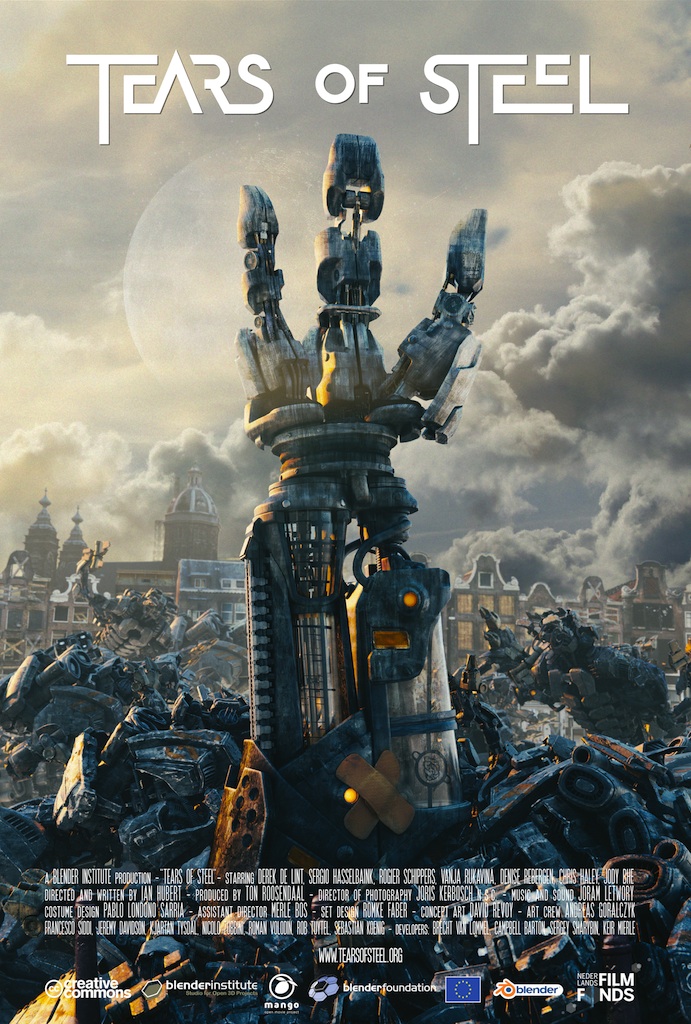


Some of the posters that I am considering taking inspiration from would be from various short films that focus around similar subjects, i.e. sci-fi, robots, machinery and the cold winter themes that run throughout the setting. for the poses and object arrangement within the poster, I will take a look at the following posters:

These give a large range of ideas for inspiration in terms of how the poster should be structured, but for the styling of the poster, I will be taking a different route. A style that makes for a very simple but eye-catching poster is using minimalist styles to represent the film, with basic colours and shapes. Alongside this, a large amount of minimalistic posters make a use of negative space to represent an image within the image, while not directly depicting said image. This is done more through the lack of imagery within a certain area (such as the posters demonstrated below).
Using a combination of these styles, I believe that the poster will conform to the conventions of object arrangement within the poster, but that the styling of the poster will help to set it apart from other short film posters.
Friday, 12 February 2016
Media Short Film - First Full Draft
The first draft of my media short film is finished! This contains all of the scenes that are in the final film.
Wednesday, 3 February 2016
New Hardware!
Recently, I purchased a new £200 graphics card for my computer. In terms of my animation, this gives me the potential to create a far better end product, as more camera effects, bigger and more expansive sets and more ambitious particle and lighting effects can be achieved. Alongside this, I may be able to complete my original intention of filming the entire short film in 60 frames per second, giving the finished result a much smoother look and finish.
With this in mind, I am altering the original story that I had in mind slightly to incorporate some of the initial ideas that I had but was at the time unable to use, such as multiple antagonists and a larger scale fight at the end. This larger scale fight will use some of the models I initially made for this project, but scrapped due to their high-requirements. Some of those are as follows:


Along with various other scenery objects (walls, platforms etc), these are some of the previous ideas that can be now incorporated into the short film, either taking on similar roles to their original intention or being changed to fit the more up to date narrative. The narrative changes effect little of the story, but are largely just a few shots placed into the pre-existing scenes in order to set up the antagonist more, as well as introducing a new plot point that will be used in the finale (a small Ipod-like device that will play a song and it's music video when one of the protagonists accidentally activates it). This will, of course, lead to changes being placed within the finale, as it will be done on a much grander scale then previously planned to be.
With this in mind, I am altering the original story that I had in mind slightly to incorporate some of the initial ideas that I had but was at the time unable to use, such as multiple antagonists and a larger scale fight at the end. This larger scale fight will use some of the models I initially made for this project, but scrapped due to their high-requirements. Some of those are as follows:

The large areal fort that the antagonists will reside in, and the protagonists will have to infiltrate


Small Drone used by the antagonists as a smaller form of henchmen (Note: This model got as far as having it's colours textured before being scrapped)
Along with various other scenery objects (walls, platforms etc), these are some of the previous ideas that can be now incorporated into the short film, either taking on similar roles to their original intention or being changed to fit the more up to date narrative. The narrative changes effect little of the story, but are largely just a few shots placed into the pre-existing scenes in order to set up the antagonist more, as well as introducing a new plot point that will be used in the finale (a small Ipod-like device that will play a song and it's music video when one of the protagonists accidentally activates it). This will, of course, lead to changes being placed within the finale, as it will be done on a much grander scale then previously planned to be.
Wednesday, 16 December 2015
Wednesday, 4 November 2015
Initial Ideas
There are three main concepts that I have in mind, all of which are similar variations on the same basic concept. They all revolve around the same plot with separate endings, some of which are similar and some which have more of a plot and character development.
The first story concept has three robotic protagonists, rusting and quickly running out of power, attempting to locate anything that will power them for longer to keep them alive. when their scanner begins to pick up a signal, they go to investigate it, and they find a battery there. The antagonist then steals this and they must retrieve it from him. This version of the short film would end in the antagonist being ripped apart by the protagonists, having grabbed onto him, while he flies around and attempts to get away, eventually crashing into the ground and shutting down. This version was rejected due to the ending being a bit disturbing, as well as seeing the antagonist literally ripped limb from limb by the protagonists would change the audience's view on whether they supported the protagonists or not.
The second concept has similar story, but some minor changes and a different ending. This concept has three robotic protagonists who are being hunted by a larger robot, styled and designed to look like a form of snake. The short film would open with a fight between them, and the antagonist would then steal all of the spare power they have. This would be what prompts them to follow the scanner and look for the battery, which the secondary antagonist steals. when they go to get it back, during the final fight, the snake reappears and the protagonists begin to panic. after one of them is killed by the main antagonist, the secondary antagonist decides to help them seeing the real danger that they face, and aids in the destruction of the main antagonist. He then helps the protagonists repair their broken friend. This version is by far the most in depth, and has better story and character development then the other ideas. However, it would also be by far too long, as the estimated run time of this would be around 10 minutes in order to use all of the camera work and techniques that I wanted too,while keeping the better plot development.
The final concept is a simplified version of the previous concepts. The film has three robotic protagonists who are on the search for more power before they run out. Following their scanner, they find a cave with a frozen door that they break through using a form of laser. Inside, they find crystals that will power them for a short while, and then a gigantic battery. the antagonist, who has been observing them, makes his move and strikes one of the protagonists down, before stealing the battery. the main protagonist hangs on to the battery as the antagonist tries to steal it, and the antagonist flies up into space in an attempt to make him let go. When he is forced off the battery, he comes crashing back to earth. When he lands, they use the scanner to find where the antagonist is located and charge into his lair. He attacks them, and they collectively try to use their lasers to destroy him. However, he manages to get one of the protagonists, and rips his arm off, using said arm to beat him to death. The other protagonists, seeing this, again use their lasers, but use them to push him over the ledge of the cave they are in and into a pit of lava, where he melts into molten metal. They take their battery and fallen friend and leave. This idea provides a good balance between the two previous ideas, taking the best of both elements and instead using the character development to further develop the audience's anger towards the antagonist.
The first story concept has three robotic protagonists, rusting and quickly running out of power, attempting to locate anything that will power them for longer to keep them alive. when their scanner begins to pick up a signal, they go to investigate it, and they find a battery there. The antagonist then steals this and they must retrieve it from him. This version of the short film would end in the antagonist being ripped apart by the protagonists, having grabbed onto him, while he flies around and attempts to get away, eventually crashing into the ground and shutting down. This version was rejected due to the ending being a bit disturbing, as well as seeing the antagonist literally ripped limb from limb by the protagonists would change the audience's view on whether they supported the protagonists or not.
The second concept has similar story, but some minor changes and a different ending. This concept has three robotic protagonists who are being hunted by a larger robot, styled and designed to look like a form of snake. The short film would open with a fight between them, and the antagonist would then steal all of the spare power they have. This would be what prompts them to follow the scanner and look for the battery, which the secondary antagonist steals. when they go to get it back, during the final fight, the snake reappears and the protagonists begin to panic. after one of them is killed by the main antagonist, the secondary antagonist decides to help them seeing the real danger that they face, and aids in the destruction of the main antagonist. He then helps the protagonists repair their broken friend. This version is by far the most in depth, and has better story and character development then the other ideas. However, it would also be by far too long, as the estimated run time of this would be around 10 minutes in order to use all of the camera work and techniques that I wanted too,while keeping the better plot development.
The final concept is a simplified version of the previous concepts. The film has three robotic protagonists who are on the search for more power before they run out. Following their scanner, they find a cave with a frozen door that they break through using a form of laser. Inside, they find crystals that will power them for a short while, and then a gigantic battery. the antagonist, who has been observing them, makes his move and strikes one of the protagonists down, before stealing the battery. the main protagonist hangs on to the battery as the antagonist tries to steal it, and the antagonist flies up into space in an attempt to make him let go. When he is forced off the battery, he comes crashing back to earth. When he lands, they use the scanner to find where the antagonist is located and charge into his lair. He attacks them, and they collectively try to use their lasers to destroy him. However, he manages to get one of the protagonists, and rips his arm off, using said arm to beat him to death. The other protagonists, seeing this, again use their lasers, but use them to push him over the ledge of the cave they are in and into a pit of lava, where he melts into molten metal. They take their battery and fallen friend and leave. This idea provides a good balance between the two previous ideas, taking the best of both elements and instead using the character development to further develop the audience's anger towards the antagonist.
Wednesday, 28 October 2015
First shot of the battery/cavern scene (Which had it's set displayed), and first shot of the short film that has been recorded!
Today I have begun animating the introduction shots to the battery/cavern scene, and have recorded the first shot of this scene. it begins with a pan down, which will be used as a transition from the previous shot, to the three protagonists arriving at the cavern's entrance. The raw footage from this, recorded straight from the engine and unedited, is shown below. The shot uses a looped animation, which is why it appears to play multiple times.
The reason this was recorded with more then one loop is that the particle effect that generates the falling snow is randomly generated as to where and how it will fall, so having three different loops allows a choice to choose the best one to transition from the first scene. initially, the footage displays a grey screen saying "scene is missing a full screen camera", which means that no rendering camera is present. this is so that the animation is not looping before the particle effect has begin to generate, and the animation only plays when the 'e' key is pressed on the key board, using a small custom script I wrote in order to control the particles. While I was hoping to record the entire film in 60 frames per second, this seems to be an impossible feat with my current equipment, and the film will likely have to be recorded in 30 frames per second.

The reason this was recorded with more then one loop is that the particle effect that generates the falling snow is randomly generated as to where and how it will fall, so having three different loops allows a choice to choose the best one to transition from the first scene. initially, the footage displays a grey screen saying "scene is missing a full screen camera", which means that no rendering camera is present. this is so that the animation is not looping before the particle effect has begin to generate, and the animation only plays when the 'e' key is pressed on the key board, using a small custom script I wrote in order to control the particles. While I was hoping to record the entire film in 60 frames per second, this seems to be an impossible feat with my current equipment, and the film will likely have to be recorded in 30 frames per second.

The custom script to activate the camera's recording
The first shot recorded of the short film
Wednesday, 21 October 2015
With the Box-bots having finished being textured, They needed a way for them to be identified separately. I tried many different ideas, but eventually settled on the idea of having them painted different colours, along with different eye colours. This is done in order to make them identifiable in both long shots and close up shots, especially if it shows only the eyes.

The base texture for the Box-bot. This provides the basis for all of the coloured bots.

The base Box-bot texture applied to the robot. As you can see, it appears colourless and bland.

The edited version of the basic texture to add a blue paintwork to some sections of the bodywork. This was done in Photoshop in order to allow me to create the different colours easier later.


The final product for the blue bot, who will be the main protagonist. note how his paint job only covers panels and crosses no faces - this is done because of the rust and scratches that exists there, making it unlikely that any paint would have survived.

The texture for the body of the orange bot. The paint job is identical, and only a hue change is used on the painted parts to keep the rust the correct colour.

The completed set of protagonists, each with different paint and eye colours. Their colours are chosen to be easily distinguishable from a distance, as well as to stand out from the background.
Wednesday, 14 October 2015
Battery Cavern Modeled, Environment and Camera Effect Testing
I have been modelling the different parts of the environmental scenes that need making, however, I have finally finished the cavern that will have the battery in it. Alongside this, the battery has been finished and has therefore been implemented into the scene. Here are some images of the different parts of the environment:


To demonstrate how this scene will actually look within the film, I have recorded a 1 minute clip of what the scene will look like with the snow particle effects on. The grass in the background also uses a wind renderer to make it seem as though it is blowing in the wind.

An overview of the environment. The grass does not span round the entire area as not all of it will be seen.

The entrance to the scene. The characters will enter through this arch.

Character's entrance on the left, entrance to the cavern on the left.

View from the inside of the cavern, facing outwards.

The inside of the cavern. The entrance to the small room with the battery is on the right, and one of the lighting crystals is on the left (the crystal is subject to change).
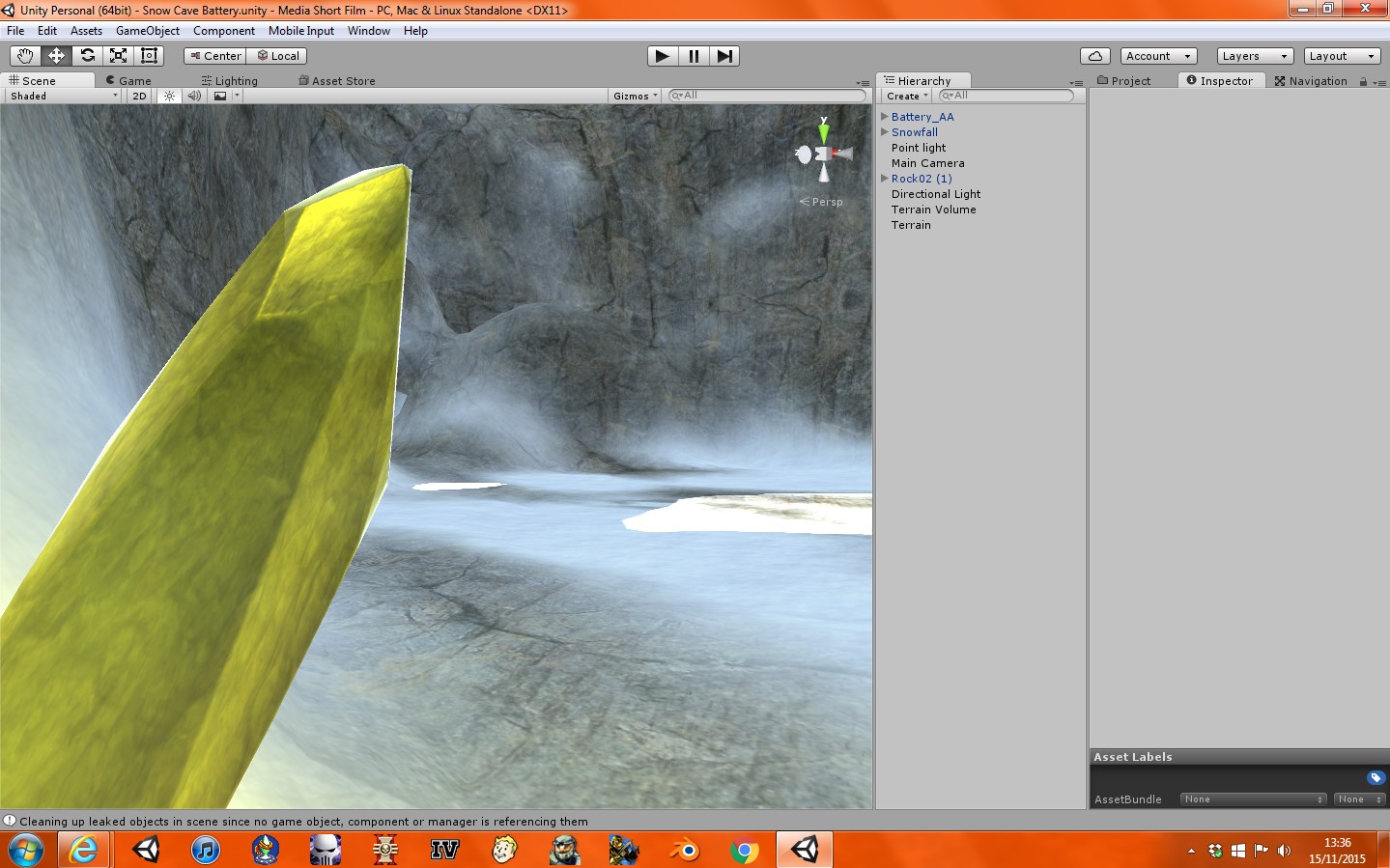
Another shot of the crystal. The crystal is slightly transparent, and the glow has been reduced (it will be brighter when a character approaches it).

The battery room of the cavern. the battery is lodged in snow, and the roof has a hole to allow light to shine on it as well as for the antagonist to escape out of.

Another angle of the battery. This better shows the hole in the roof.
The shots demonstrated here are good, but they are not good enough, as they look rather bland. Therefore, I would like to apply camera effects and changes to the world cameras that the short film will be recorded through. Here is a list of shots taken with in-game cameras:


Here are the same shots, but with camera effects applied. No external editing software (Photoshop, after effects, Sony Vegas etc.) was used for making these images, and were all done in engine. Alongside this, a snow particle effect has been added.


To demonstrate how this scene will actually look within the film, I have recorded a 1 minute clip of what the scene will look like with the snow particle effects on. The grass in the background also uses a wind renderer to make it seem as though it is blowing in the wind.
Subscribe to:
Posts (Atom)